

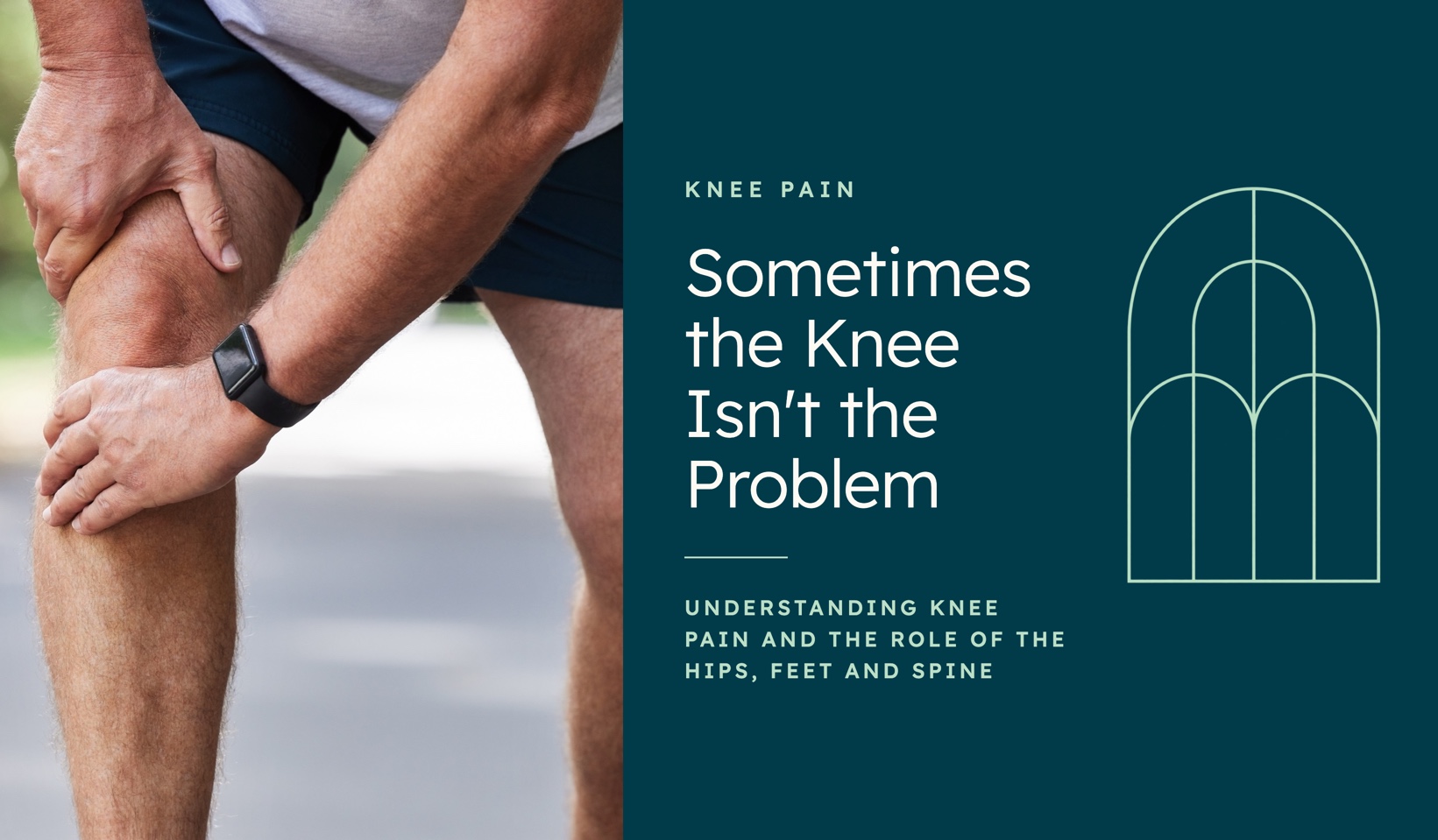
If you’re struggling with knee pain, you’ve probably spent a lot of time focusing on the knee itself.
You’ve stretched it, strengthened it, foam rolled it, iced it, rested it, and perhaps even had scans or treatments directed specifically at the knee. Yet for many people, the pain keeps returning every time they go for a run, climb stairs, squat, or get back into exercise.
If that sounds familiar, you’re not alone.
One of the most important things we explain to patients is that pain and dysfunction are not always found in the same place. While the knee may be where you feel the pain, the underlying cause can sometimes come from elsewhere in the body.
Knee pain can present in many different ways.
Some people experience pain around the kneecap, while others feel discomfort on the inside, outside, or back of the knee. For runners, symptoms often begin gradually and worsen with distance or intensity.
Common symptoms include:
Many people notice that the knee feels fine at the start of activity but becomes increasingly painful as they continue moving.
The knee sits between the foot and the hip.
Every step you take, every squat you perform, and every kilometre you run requires forces to be transferred efficiently through the entire body. If movement is not being controlled properly elsewhere, the knee is often the structure that ends up paying the price.
This is particularly common in runners.
We often see people whose knee pain only appears after several kilometres of running. The knee itself may initially be functioning perfectly well, but as fatigue develops, poor load transfer through the pelvis, lower back, hips, or ankle begins to place increasing stress on the knee joint.
Over time, this can contribute to irritation of the tissues around the knee and recurring pain.
More than most people realise.
The lower back and pelvis play a crucial role in controlling how forces travel through the body. If the joints, muscles, or nervous system are not coordinating effectively, movement patterns can change further down the chain.
We frequently see people with knee pain who also have:
When the pelvis and lower back are not transferring load efficiently, the knee often has to compensate.
This doesn’t necessarily mean the knee is damaged. It may simply be working harder than it was designed to.
The ankle is another commonly overlooked contributor.
A loss of ankle mobility can significantly change the way forces move through the leg during walking, running, squatting, and jumping.
If the ankle cannot move properly, the knee is often forced to compensate.
This is why we frequently assess ankle mobility, balance, and movement control when evaluating knee pain.
Surprisingly, yes.
The nervous system controls every movement you make. The neck contains an incredibly high concentration of sensory receptors that constantly provide the brain with information about body position, balance, and movement.
When this information becomes altered, it can influence coordination and movement patterns throughout the body.
While not every knee problem originates from the neck, we occasionally see improvements in balance, coordination, and lower limb function after addressing dysfunction higher up the chain.
This is one reason why we assess the body as a whole rather than focusing solely on the area that hurts.
Absolutely.
Not all knee pain originates elsewhere.
Previous injuries, ligament sprains, cartilage irritation, meniscus injuries, and osteoarthritis can all contribute to knee pain and reduced function.
While we cannot reverse structural damage or regrow a damaged meniscus, many people are surprised by how much improvement is still possible. By improving movement, restoring mobility where appropriate, reducing compensation patterns, and helping the body distribute load more effectively, we can often help people move with greater comfort and confidence.
At The Third Space, we don’t just examine the knee.
We assess how the entire system is working together. This includes the knee itself, but also the ankle, hip, pelvis, lower back, movement patterns, balance, and nervous system function.
Our goal is to understand why the knee is being overloaded rather than simply treating the painful area.
For some people, the answer lies in the knee itself. For others, the biggest contributor may be the ankle, pelvis, lower back, or a combination of several factors.
By identifying these contributing factors, we can create a personalised chiropractic plan designed to improve movement, reduce stress on the knee, and help you return to the activities you enjoy.
Whether you’re dealing with runner’s knee, recurring knee pain during exercise, pain around the kneecap, or symptoms that keep returning despite treatment, we’re here to help.
At The Third Space in Amsterdam Oost, we take the time to understand how your entire body moves and functions, not just where the pain is located.
Because sometimes the key to solving knee pain isn’t found in the knee at all.