

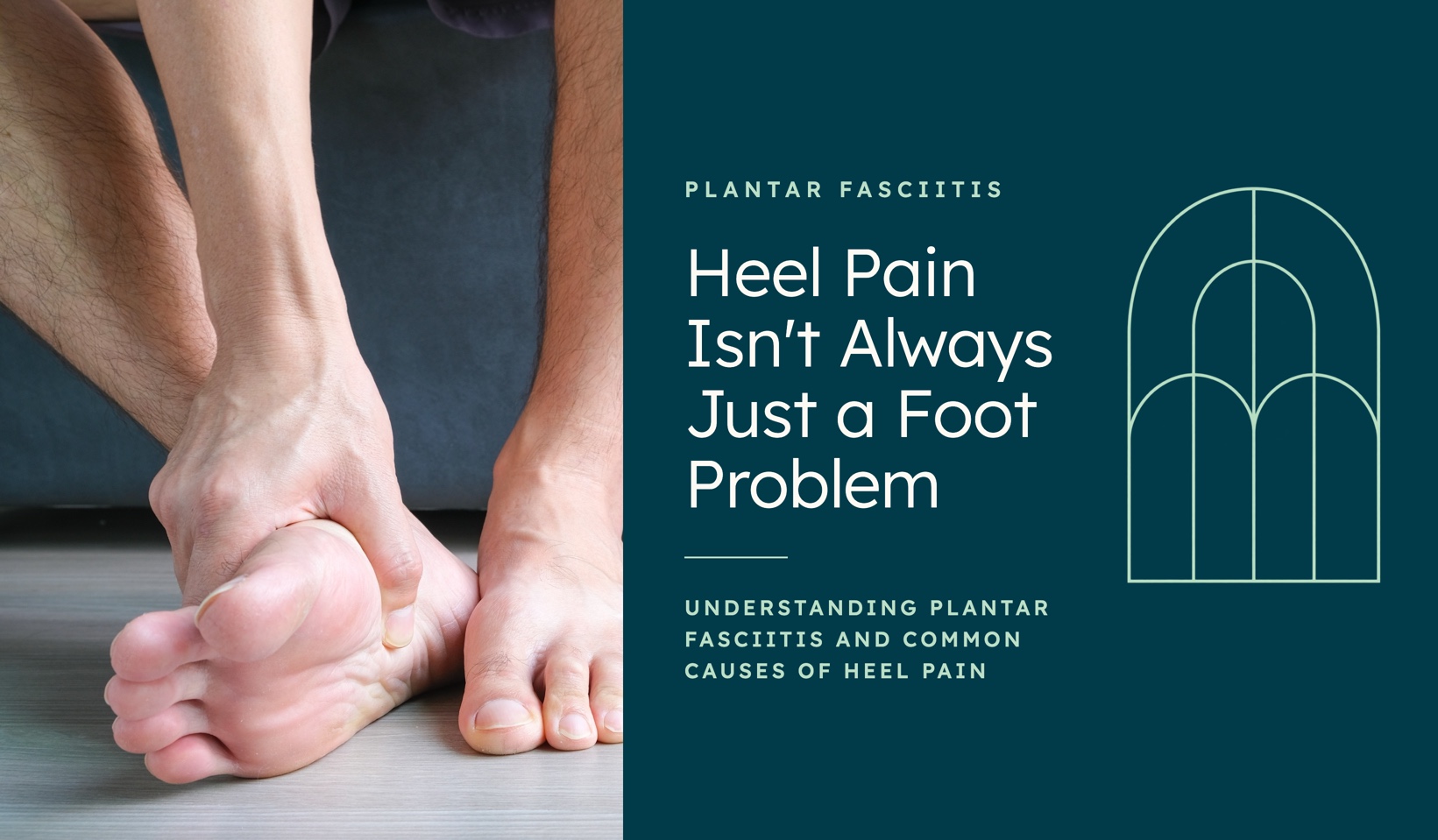
Does your heel hurt when you get out of bed in the morning? Does it ease after a few minutes of walking, only to become painful again after a long day on your feet?
These are classic signs of plantar fasciitis, one of the most common causes of heel pain. However, the plantar fascia is often the tissue that becomes painful, not necessarily the reason the problem developed in the first place.
At The Third Space, we look beyond the heel to understand why the plantar fascia is being overloaded.
Plantar fasciitis often causes:
The plantar fascia is a thick band of connective tissue that runs from your heel to your toes. It supports the arch of your foot and acts like a spring, storing energy as your foot lands and releasing it as you push off to take your next step.
Every step places force through this tissue. Over thousands of steps each day, even small changes in the way your body moves can gradually increase the load placed on the plantar fascia.
Plantar fasciitis is rarely caused by one awkward step.
More commonly, it develops when the amount of force passing through the plantar fascia gradually exceeds what it can comfortably tolerate. This might happen after increasing your running, standing for long hours at work or following an ankle sprain that never fully recovered.
But sometimes the source of the overload is further up the body.
Your pelvis, hips, knees, ankles and feet all work together to absorb and transfer force every time you walk. If movement is reduced in one area, another part of the chain has to compensate. Over time, the plantar fascia may simply become the tissue that starts to complain.
Not necessarily.
Pain under the heel can also be caused by irritation of nearby nerves, the heel fat pad, stress injuries or other conditions that closely resemble plantar fasciitis. This is why a careful assessment is important rather than assuming every painful heel has the same cause.
Because the problem isn’t always isolated to the foot, neither is our assessment.
At The Third Space, we examine not only the foot and ankle, but also the knee, hip and lower back to identify areas that may be changing how force is transferred through the leg. Gentle chiropractic adjustments aim to restore movement to joints that have become stiff, helping the body absorb and distribute load more efficiently rather than repeatedly overloading the plantar fascia.
Our goal is not simply to treat your heel pain, but to address the movement patterns that may be contributing to it in the first place.
Whether you’ve recently developed heel pain or it’s been bothering you for months, identifying why the plantar fascia is overloaded is often the key to lasting improvement.
At The Third Space in Amsterdam-Oost, we provide thorough chiropractic assessments and personalised treatment plans to help reduce heel pain, improve movement and get you back to walking, running and everyday life with confidence.